5 Days Across Bhutan’s Sacred Valleys and High Passes

5 Days Across Bhutan’s Sacred Valleys and High Passes

5 Days Across Bhutan’s Sacred Valleys and High Passes

5 Days Across Bhutan’s Sacred Valleys and High Passes

Dzongs & High Passes

From From From US$3,495 per person · Min. 6 riders · Includes flights Kathmandu–Paro (Bhutan)

Duration: 7 Days

May 05 – May 12, 2026

Status: Open

Oct 25 – Oct 31, 2026

Status: Open

Dec 02 – Dec 08, 2026

Status: Open

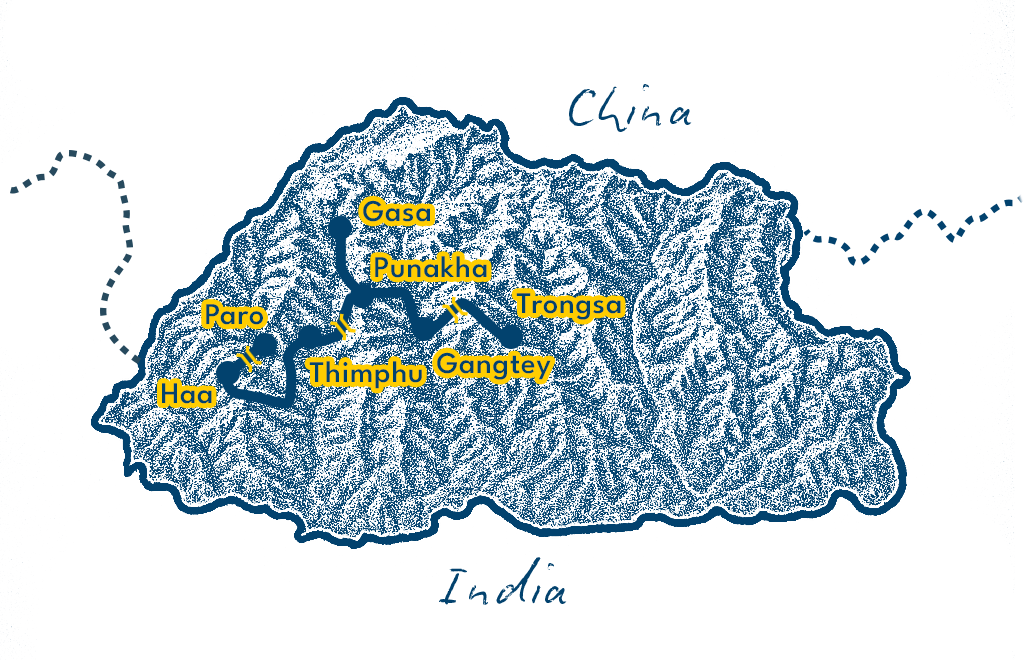
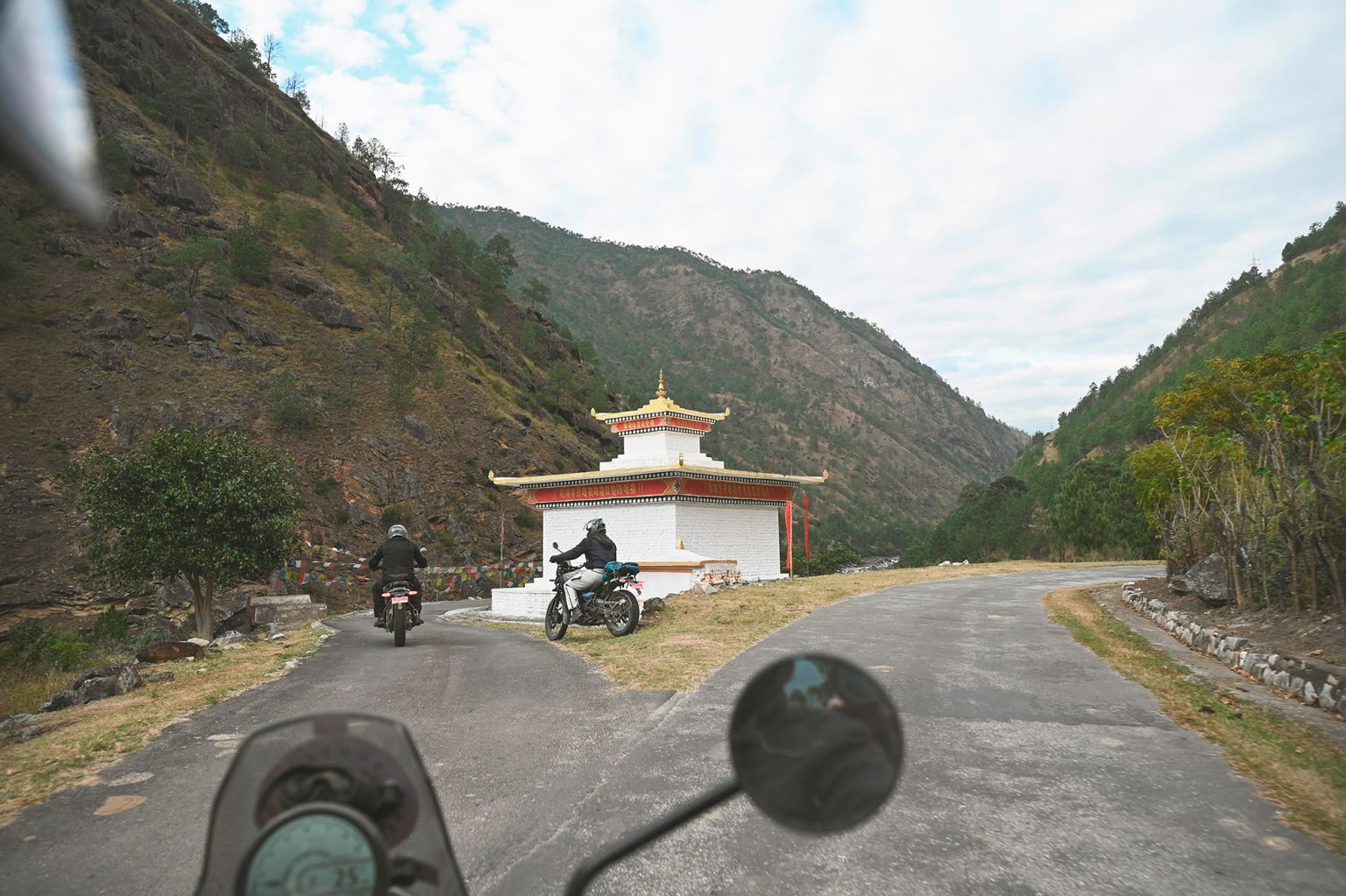
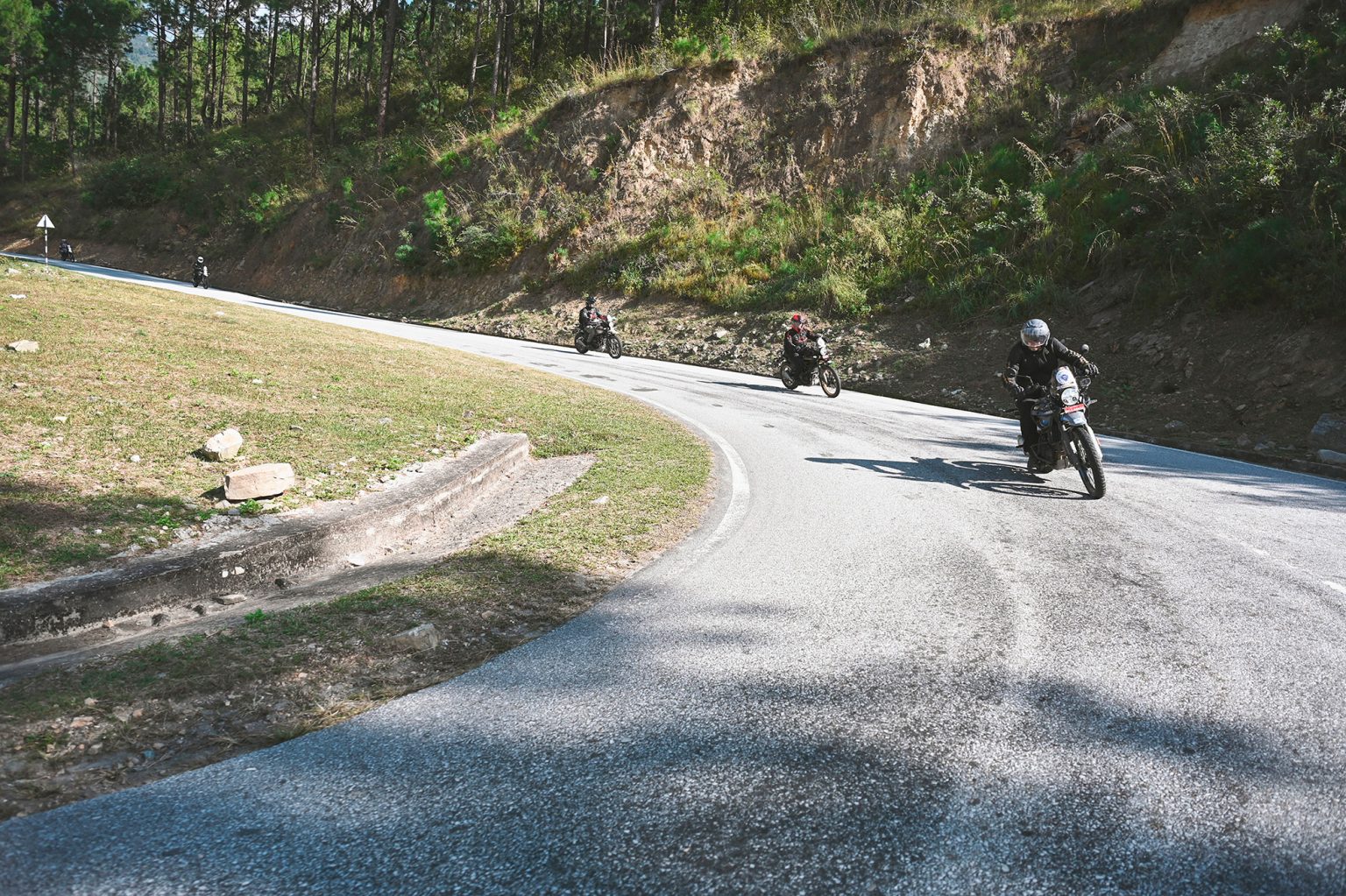
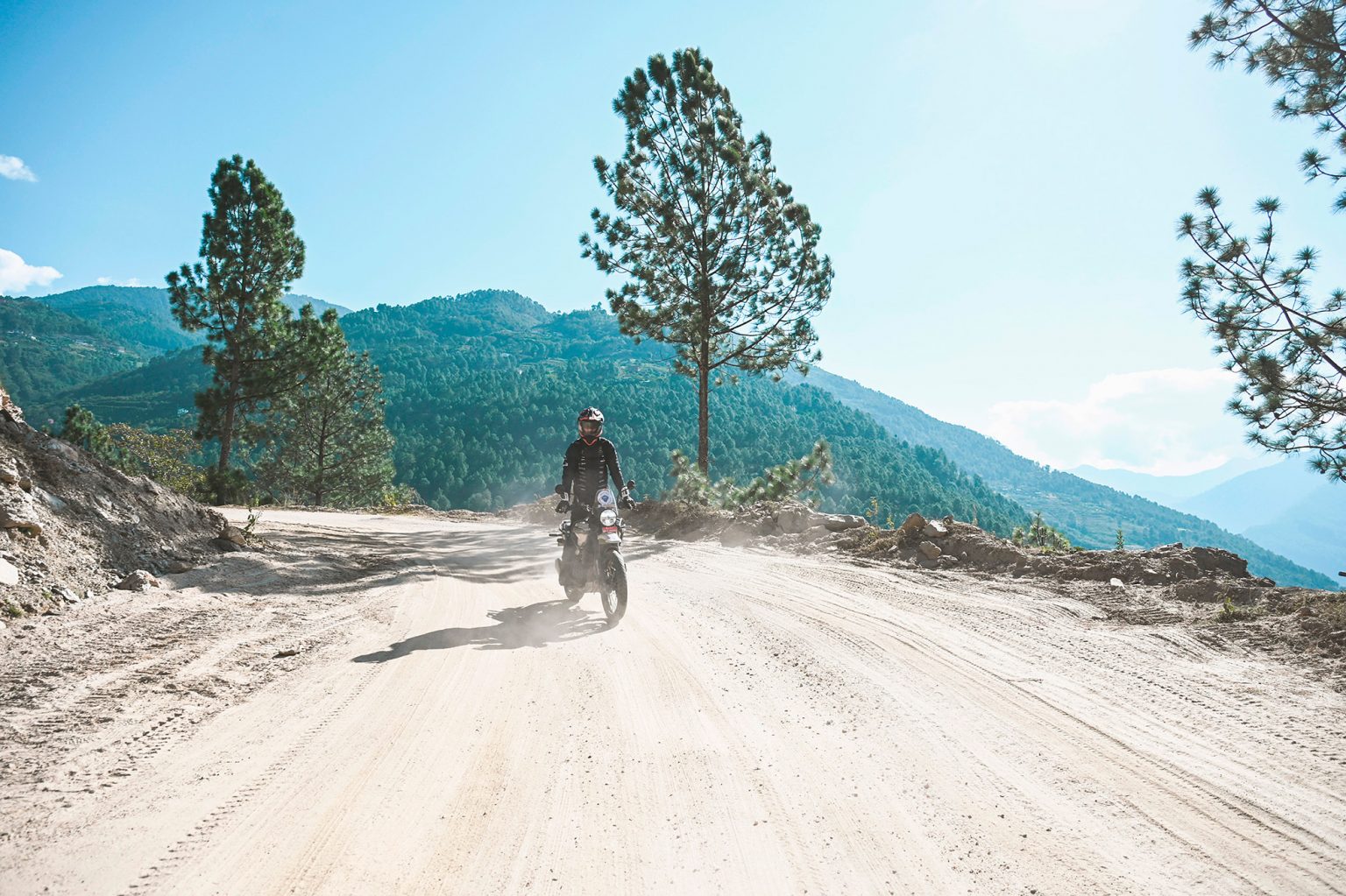
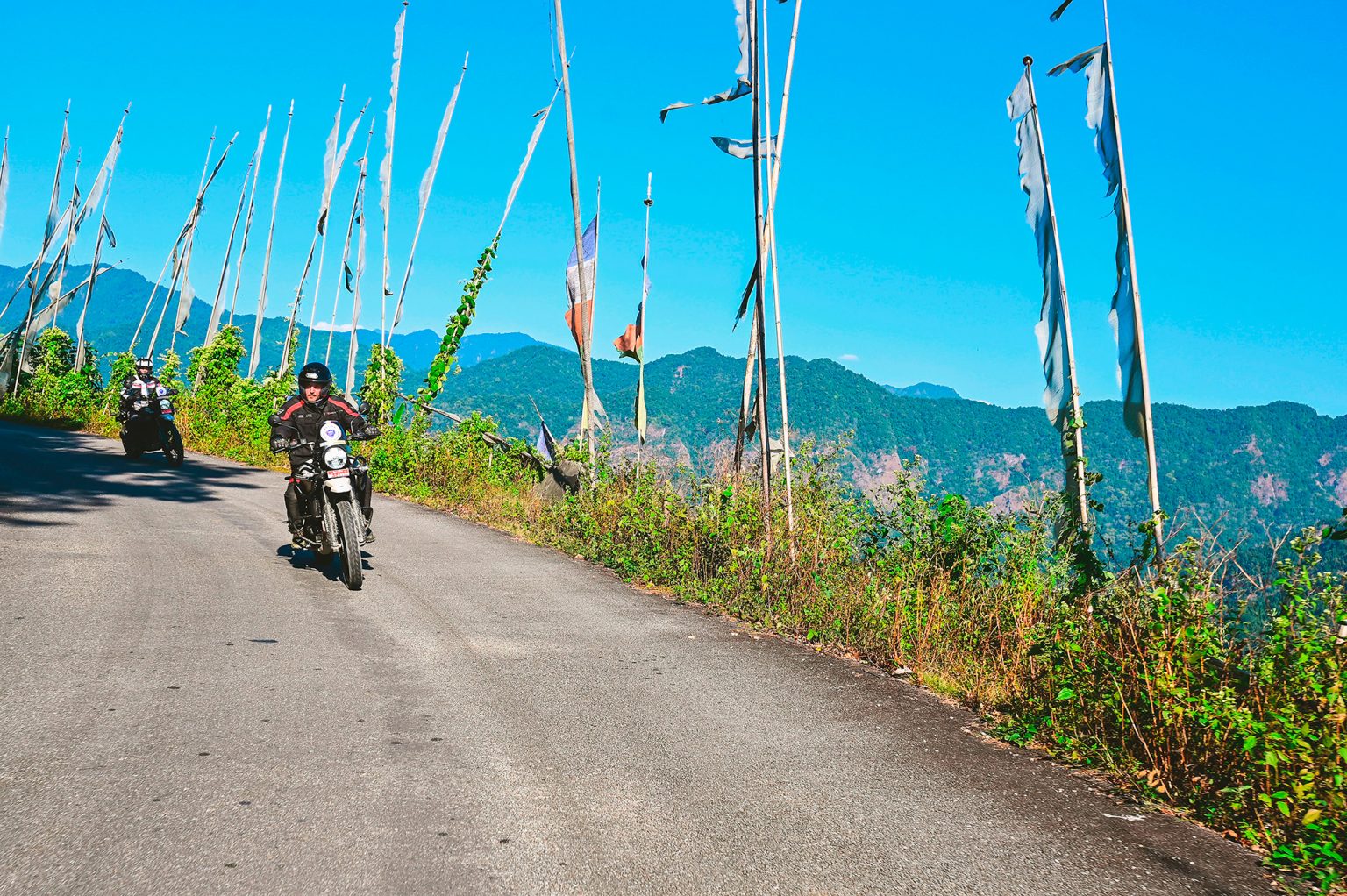
Focusing on Bhutan’s legendary east–west highway as far as Trongsa, this compact circuit captures the very essence of riding in the kingdom — without compromise. Built around five excellent, full riding days, the journey prioritises long, flowing mountain roads and meaningful time in the saddle. From the historic valley of Paro to the hidden Haa Valley, then onward through Thimphu, Punakha, Phobjikha, and Trongsa, the route weaves together spiritual discovery, dramatic landscapes, and the pure joy of riding some of the world’s most spectacular mountain roads. Each day reveals a new facet of Bhutan — snow-dusted passes strung with prayer flags, quiet monasteries, ancient dzongs, pine forests, rice terraces, and timeless rural life. Designed for riders seeking both adventure and meaning, this is more than a short ride; it is a concentrated immersion into the spirit of Bhutan, where the quality of the riding is never compromised and every moment in the saddle truly counts.

Dzongs and High Passes
Approx. distance: ~160 km
Altitude range: 2,200 m → 3,100 m → 1,200 m
Riding time: 4–5 hours (plus stops, lunch & visits)
Arrive in Paro, where the dramatic Himalayan approach offers a fitting welcome to Bhutan. After completing arrival formalities, you transfer to Thimphu, stopping for lunch along the way as the landscape shifts from wide valley floors to forested hillsides.

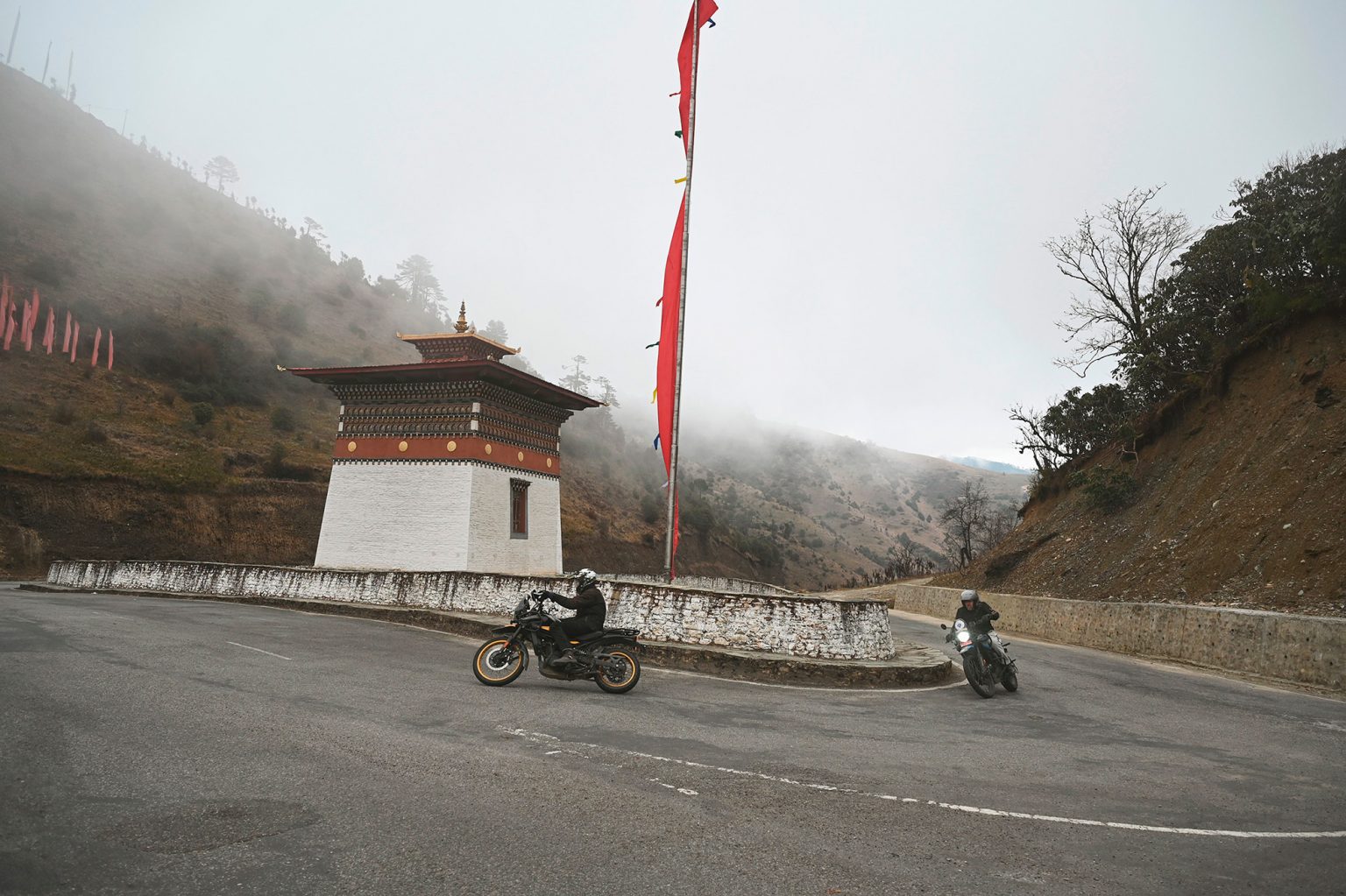
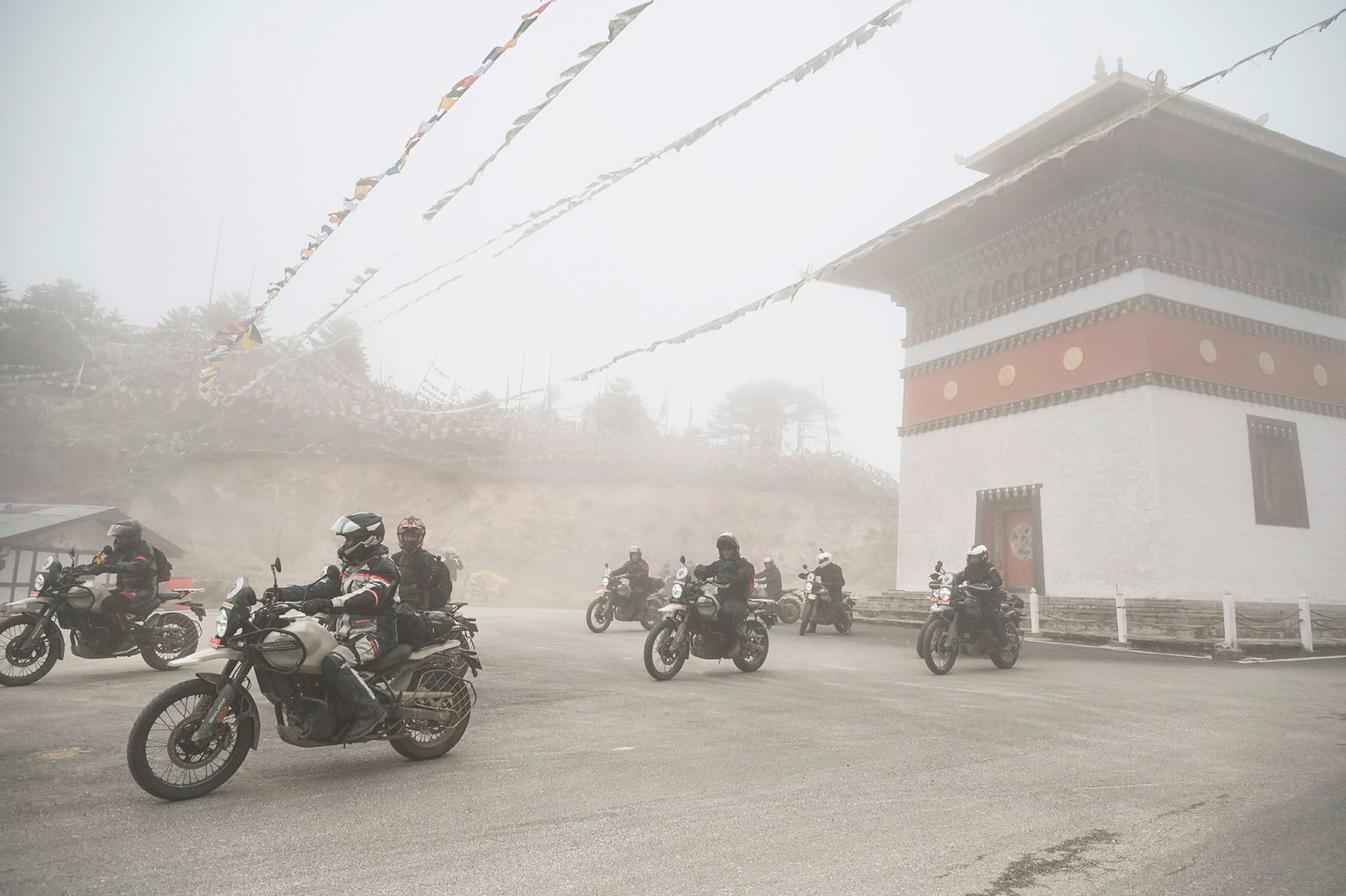
In Thimphu, meet your guides and collect your Royal Enfield motorbikes, followed by a short briefing to familiarise yourself with the bikes and the style of riding in Bhutan. The afternoon ride begins with a gentle climb to the iconic Buddha Dordenma, where the golden statue gazes serenely across the Thimphu Valley — a calm and inspiring place to begin the journey. Leaving the city behind, the road climbs steadily through cool pine forests toward Dochula Pass (3,100 m). Crowned by 108 white chortens and lined with prayer flags, Dochula offers sweeping Himalayan views on clear days and a quiet, meditative atmosphere when mist rolls in.

Dropping down from the cool mountain air, the landscape shifts dramatically as the road winds into the Punakha Valley (1,200 m). Pine forests give way to terraced rice fields, riverside villages, and fertile hillsides, with the riding becoming warmer, smoother, and more relaxed as the high Himalayas fade into lush greenery.

Descending to the valley floor, the route reaches the bridge at Wangdi, beneath the impressive Wangdue Phodrang Dzong, which historically guarded the route south toward India and norrth to Tibet.  After settling in, gather for a relaxed evening, reflecting on a first day that has already delivered high passes, sacred landmarks, and one of Bhutan’s most beautiful valleys.

Distance: approx. 142 km
Riding time: approx. 5–6 hours (excluding sightseeing stops)

Leaving Punakha after breakfast, you follow the river briefly before the road begins to climb steadily out of the warm subtropical valley. Almost immediately, the riding character changes — tighter bends, cooler air, and long mountain gradients as you head east into Bhutan’s central highlands.

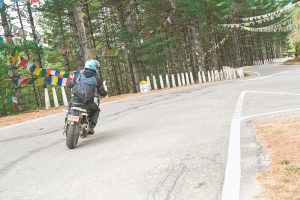
The route passes through Wangdue Phodrang, an important regional centre, before continuing deeper into forested hills and increasingly remote terrain. Dense pine and rhododendron forests line the road, broken by small villages, prayer wheels, and roadside chortens. Traffic is minimal, and the riding feels calm, rhythmic, and immersive — classic Bhutan.

As you gain altitude, the road climbs toward Pele La Pass (3,420 m), the traditional boundary between western and central Bhutan. Prayer flags mark the pass, and views open across rolling ridgelines of the Black Mountains. It’s a natural pause point — not just for photographs, but to absorb the sense of transition as you leave western Bhutan behind.

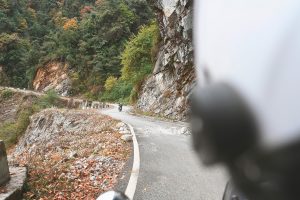
From Pele La, the descent toward Trongsa is one of the most dramatic rides in the country. The road drops steeply through dense forest and deep valleys, with spectacular viewpoints high above the Mangde Chhu River far below. Long descents, sweeping bends, and changing light make this a deeply satisfying stretch of road.

By early to mid-afternoon, you arrive in Trongsa, long regarded as the strategic and spiritual heart of Bhutan. Perched dramatically on a ridge above the gorge, Trongsa Dzong dominates the landscape. Time is set aside to explore this extraordinary fortress — the largest dzong in Bhutan and the ancestral home of the Wangchuck royal family. Its interconnected courtyards, watchtowers, temples, and passageways offer commanding views and a powerful insight into Bhutan’s history, monarchy, and spiritual life.

The evening is spent overnight in Trongsa, surrounded by cool mountain air and sweeping valley views. As the light fades over the gorge below, the day ends with a deep sense of having crossed into the true interior of Bhutan — a rewarding and memorable Himalayan riding day.
Distance: approx. 230 km
Riding time: approx. 7–8 hours (including stops)

Leaving Trongsa early, you climb back toward Pele La Pass (3,420 m), riding through dense forest and high ridgelines of the Black Mountains. Morning light and cool air make this a superb stretch of road, with flowing bends and minimal traffic.

After crossing Pele La, the route turns west toward Gangtey and the wide, glacial basin of the Phobjikha Valley. At around 2,900 m, the scenery opens dramatically, offering a striking contrast to the deep gorges you’ve left behind. Time is set aside to visit Gangtey Monastery, beautifully positioned above the valley, and to take in views across this important conservation area. In season, the endangered black-necked cranes can often be seen feeding in the fields below.

From Gangtey, the road descends steadily toward Wangdue Phodrang, with long downhill sections and changing landscapes as altitude is lost. By early afternoon, you arrive back in the warmer Punakha Valley, where lunch is taken at a relaxed local restaurant — a chance to refuel and take a break before the final push north.

After lunch, the ride continues along the river before turning onto the quieter road that leads toward Gasa. Traffic thins rapidly as you head deeper into one of Bhutan’s most remote districts. The road narrows and climbs steadily through forested slopes and high valleys, following rivers and ridgelines toward the far north of the country.

You arrive in Gasa by late afternoon or early evening. Surrounded by high mountains and deep silence, Gasa feels remote, traditional, and unchanged by time. Known for its isolation and nearby hot springs, it offers a powerful sense of arrival and a memorable end to one of the most adventurous riding days of the journey.

Distance: approx. 150 km
Riding time: approx. 5–6 hours (plus stops)

Today marks the penultimate day of riding, guiding you back toward Bhutan’s capital while leaving space to savour the final moments of the journey. Departing Gasa after breakfast, the road follows the Mo Chhu River south through quiet, forested valleys. The riding is relaxed and scenic, with gentle curves and river views as you leave the remote north behind.

By late morning, the landscape opens into the warmer Punakha Valley, where you stop for lunch — a welcome break to rest, refuel, and reflect on the journey so far in a low-valley setting.

In the afternoon, the road climbs steadily toward Dochula Pass (3,100 m). As altitude is gained, the air cools and forests thicken, and the riding becomes smooth and flowing. If skies are clear, late-afternoon light at Dochula offers one final iconic Himalayan moment, with the 108 chortens glowing softly and distant ridgelines stretching across the horizon.

From Dochula, a smooth descent brings you back into Thimphu, returning to the same hotel as earlier in the journey. With the riding day complete, there is time to enjoy a little of town life in Bhutan’s small and distinctive capital — perhaps some relaxed shopping, a café stop, or a final kora at the Thimphu Memorial Chorten, bringing the journey full circle before the final day.

Distance: approx. 185 km
Riding time: approx. 6–7 hours (plus stops)

The final riding day delivers one of Bhutan’s most scenic and rewarding routes. Leaving Thimphu after breakfast, you head west on quiet mountain roads before turning toward the remote Haa Valley, a region long closed to visitors and still largely untouched by tourism.

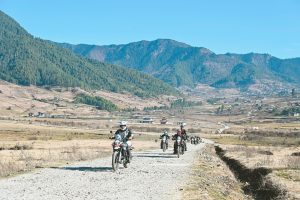
The ride into Haa is relaxed and beautiful, passing through forests, open pastureland, and traditional villages where daily life unfolds at an unhurried pace. The valley itself feels calm and spacious, framed by high ridgelines and scattered farmhouses — a final glimpse of Bhutan’s rural heartland.

From Haa, the road climbs steadily toward Chele La Pass (3,988 m), the highest motorable road in Bhutan. As altitude increases, the air becomes crisp and views expand dramatically. On clear days, the panorama includes sweeping Himalayan ridges and, in the distance, the sacred peak of Jomolhari rising above the horizon. Prayer flags whip in the wind at the pass, marking a powerful high point of the journey — both physically and symbolically.

The descent from Chele La into the Paro Valley is a fitting finale: long, flowing bends, pine forests, and wide views as the road drops toward one of Bhutan’s most iconic valleys. By mid to late afternoon, you arrive in Paro, rolling back into civilisation after days of remote mountain riding.

The evening is spent overnight in Paro, with time to relax, celebrate the journey, and reflect on a remarkable ride across Bhutan — from high passes and deep valleys to quiet backroads and timeless landscapes.

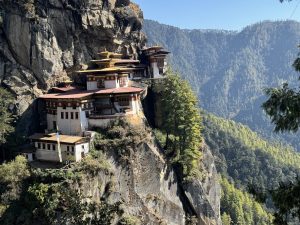
No biking today — instead, you conclude your Himalayan adventure with Bhutan’s most iconic and deeply symbolic experience: the pilgrimage to Paro Taktsang, the legendary Tiger’s Nest Monastery. To enjoy the cooler air and quieter trails, the walk begins early at 7:00 am.

The 5–6 hour round-trip hike winds steadily upward through pine forests scented with incense, juniper, and prayer flags, opening to sweeping views across the Paro Valley far below. With each step, the outside world falls away, replaced by a growing sense of calm, purpose, and quiet anticipation. According to legend, Guru Rinpoche flew to this sheer cliff on the back of a tigress in the 8th century, meditating here and bringing Buddhism to Bhutan.

Standing at the monastery, suspended between sky and earth, it is impossible not to feel both humbled and inspired. The stillness, the scale, and the devotion embedded in this sacred place create a moment of profound reflection — a fitting and unforgettable conclusion to the ride.

As you descend back toward Paro, there is time to reflect on the roads travelled, the passes crossed, the friendships formed, and the spirit of Bhutan that now travels with you — not simply as a memory, but as something quietly woven into the journey ahead.


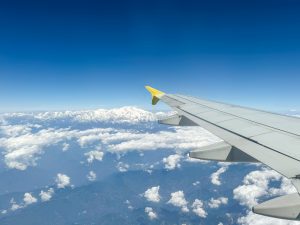
Himalayas From Plane

After breakfast, it’s time to bid farewell to Bhutan, the Land of the Thunder Dragon. You transfer to Paro International Airport for your onward flight, carrying with you unforgettable memories of an extraordinary Himalayan journey.

From the sweeping high passes of Chele La to the serene valleys of Haa and Bumthang, every kilometre has revealed a different facet of Bhutan — its raw beauty, deep spirituality, and timeless rhythm of life. The roads, the people, the rituals, and the landscapes all combine to create an experience far beyond a simple ride.

As your flight lifts above the mountains, take one last look at the valleys and ridgelines that defined the adventure — a fitting farewell to the Thunder Dragon Ride, an experience that will stay with you long after the journey ends

Gallery

◉ Ride through the heart of Bhutan on quiet, flowing Himalayan roads

◉ Cross iconic high passes including Dochula, Pele La, and Chele La (3,988 m), Bhutan’s highest motorable road

◉ See Bhutan’s most important dzongs: Punakha, Paro, Wangdue (Wangdi), Trongsa, Gangtey, and the remote Gasa Dzong

◉ Experience the vast openness of the Phobjikha Valley and the quiet beauty of Haa Valley

◉ Ride up to Gasa, one of Bhutan’s most remote and least-visited districts

◉ Complete the journey with a pilgrimage to Tiger’s Nest Monastery

◉ A delivering maximum riding, culture, and altitude

  • Group Size: 2–10 riders per departure, ensuring a personal experience.
  • Riding Skill: Suitable for experienced riders; roads are paved but mountainous, with many curves and high passes.

  • Altitude: Routes range from around 1,200 m in the Punakha Valley to nearly 4,000 m at Chele La Pass, with acclimatisation built into the itinerary.

  • Support: Every trip includes a professional Bhutanese motorbike guide riding with the group, a mechanic riding with the group (whose bike serves as the spare bike if needed), and a back-up support vehicle with driver carrying luggage, tools, and spare parts. The vehicle is available at any time should a rider need assistance or a rest day off the bike. This is the minimum level of support we offer, providing the best possible coverage for all incidents.

  • Safety: Guides are trained in first aid, with support always close at hand.

  • Connectivity: Wi-Fi is available at most hotels, but expect patchy coverage in remote areas — part of Bhutan’s charm.

✓ International flights Kathmandu–Paro–Kathmandu, including PBH (Paro) and KTM (Kathmandu) airport taxes
– Clients wishing to fly from Bangkok or Delhi: prices available on request
✓ International arrival and departure transfers in Kathmandu
✓ Single pick-up (from) and drop-off (to) Hotel Shanker in Kathmandu (recommended group hotel) for the Bhutan flights
✓ Airport transfers within Bhutan
✓ Motorbike rental (Royal Enfield Himalayan 450) and fuel
✓ Back-up support vehicle for luggage and emergencies
✓ Professional Bhutanese motorbike guide (riding with the group)
✓ Mechanic riding with the group, plus spare bike and essential parts
✓ Accommodation throughout the trip (Bhutan)
✓ All meals (breakfast, lunch, dinner, tea/coffee)
✓ Entry fees to monuments, dzongs, and museums
✓ Bhutan government royalties, taxes, and permit fees
✓ Motorbike insurance for major accidents only, covering the bike and third-party damage
– This insurance does not cover medical expenses or evacuation
– Riders must hold their own comprehensive travel insurance, explicitly covering motorbike riding, medical treatment, and emergency evacuation

Personal travel insurance (mandatory; must explicitly cover motorbike riding, medical treatment, and emergency evacuation)
⨯ Personal riding gear (helmet, boots, jacket, gloves, etc.)
⨯ Alcohol, soft drinks, and snacks outside meals
⨯ Optional single-room supplement
⨯ Tips for staff (entirely at your discretion)
⨯ US$300 cash damage deposit per rider, payable locally, to cover minor damage, scratches, or incidental repairs to the motorbikes (refundable at the end of the trip, subject to inspection)
⨯ Hotels in Kathmandu
– We normally recommend Hotel Shanker, Kathmandu, as the group meeting point
– Accommodation can be booked on your behalf and paid directly at the hotel

Every night on the ride is carefully chosen to be more than just a place to sleep. We stay in a thoughtfully curated mix of comfortable hotels, boutique lodges, eco-retreats, and traditional Bhutanese farmstays, all locally owned and rich in character.

These are places that reflect Bhutan’s culture and landscapes — warm hospitality, peaceful settings, and genuine connections with the people who live here. After long days in the saddle, you’ll enjoy hot showers, clean and comfortable rooms, and generous home-cooked meals, allowing you to rest well and fully recharge for the next day’s ride.

Accommodation is offered on a twin-share basis, with a single supplement available on request.

Open Quote

Riding the 5-day Dzongs & High Passes tour was an unforgettable introduction to Bhutan — epic high passes, quiet valleys, and sacred places throughout. The only problem is it’s left me wanting more… so I’ll be back.

Open Quote
Share this trip

Enquire now

View all our tours